Part 1 of four-part series: Fan System Effects
Fan system effects are performance losses caused by poor airflow conditions at or near a fan’s inlet or outlet, such as swirl, turbulence, abrupt transitions, fittings too close to the fan, or other obstructions in the ductwork. For engineers, contractors, and specifiers, the practical issue is simple: the fan may be selected correctly on paper, yet still deliver less airflow, lower pressure, higher noise, and more vibration once installed.
What Fan System Effects Are
A fan is tested and rated under controlled laboratory conditions, but real installations often change the airflow pattern before it reaches the impeller or after it is discharged. Those installation-related losses are called system effects, and they are not the same as normal duct friction. They come from disturbed flow caused by the fan-to-system connection itself. System effects can occur at the inlet, outlet, or both.
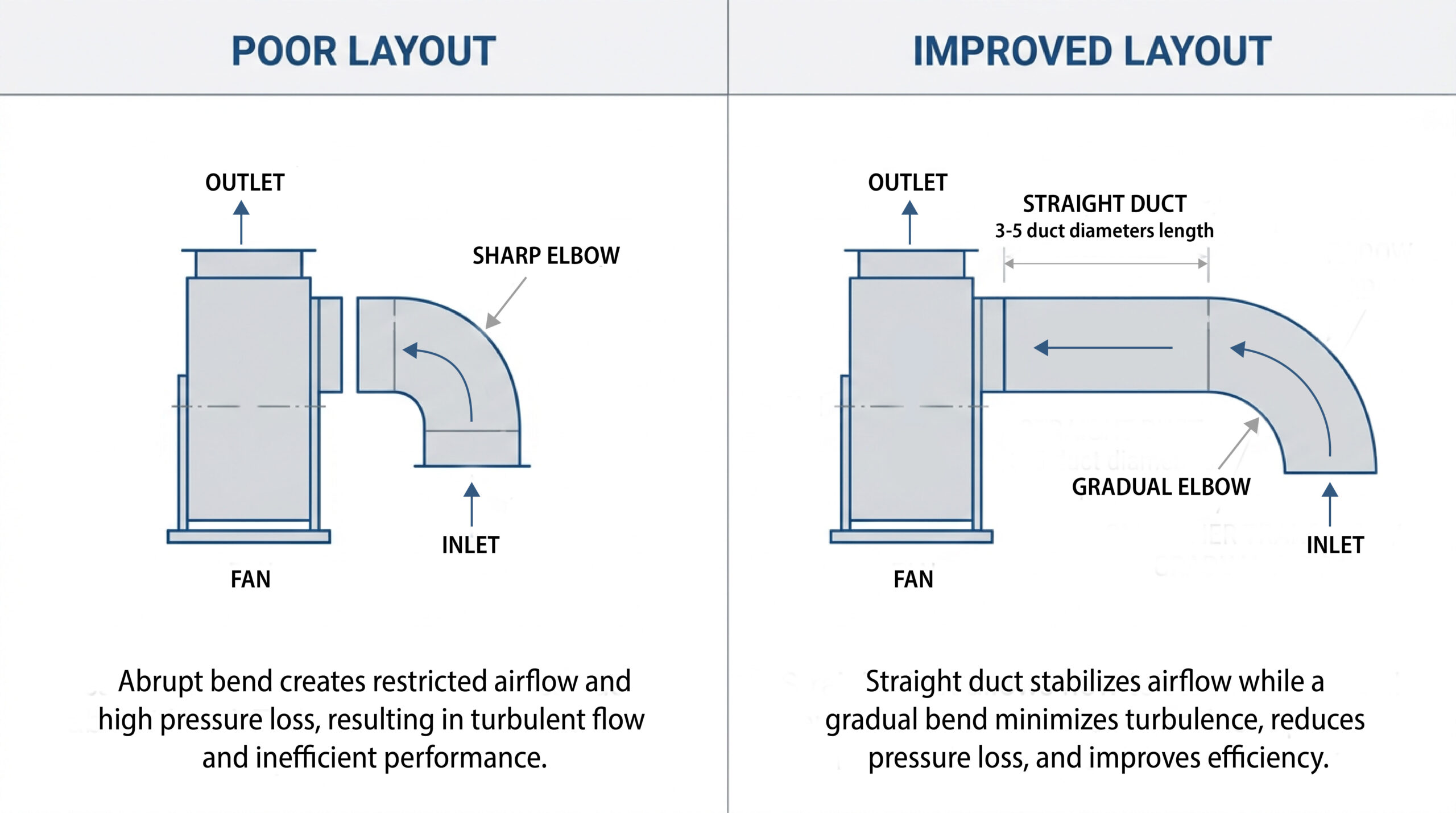
A common example is an elbow placed too close to the fan inlet, which creates swirl and uneven velocity distribution as air enters the impeller. Another is a fan discharging directly into a plenum or an abrupt expansion, which prevents the air from developing properly and can reduce performance. Poorly arranged transitions, dampers, inlet boxes, guards, and nearby walls can all contribute.
How Performance Changes
The most visible symptom is usually a drop in delivered airflow compared with the design point. To recover the required flow, the fan often has to run at a higher speed, which raises power demand, energy cost, vibration, and noise. In many cases, the fan also moves away from its best-efficiency region, so the system pays a double penalty: more input power for less useful airflow.
System effects can also make fan test results look confusing in the field. A fan can appear undersized when the real issue is that the installation is distorting the flow. Over time, the added stress can contribute to premature bearing or impeller problems and unplanned downtime.
How to Recognize System Effects
Look for a mismatch between expected and measured performance: lower airflow than design, higher-than-expected motor current, unstable static pressure, excess noise, or vibration. If the fan curve says the fan should be performing well but the installed unit is not, the problem is often in the duct arrangement rather than the fan selection. System effects are especially likely when a fan is installed near elbows, dampers, transitions, wall openings, or abrupt changes in cross-sectional area.
A useful field check is to inspect both sides of the fan for flow quality. The inlet should be uniform, symmetrical, and free of swirl, while the outlet should allow the air to diffuse and develop without immediate disruption. If the installation violates those conditions, the measured performance shortfall may be a system effect problem rather than a fan defect.
How to Correct Them
The best fix is usually geometric, not mechanical. Common remedies include rerouting ductwork, increasing straight duct lengths, moving elbows farther away from the fan, adding turning vanes, improving transitions, removing obstructions, and correcting bad inlet or outlet connections. In some cases, selecting a larger fan or increasing fan speed can compensate, but that usually increases energy use and may require larger motors and upgraded electrical components.
For specifiers, the lesson is to design the fan-system interface intentionally, not as an afterthought. Provide adequate straight duct runs, avoid abrupt changes in area or direction near the fan, and account for accessories and nearby structures that disturb the flow. For contractors, the installation should preserve the intended inlet and outlet conditions rather than forcing the fan to recover from a poor layout.
Practical Examples
- A supply fan with an elbow immediately off the outlet may not develop the published airflow because the elbow creates additional loss and nonuniform discharge.
- An exhaust fan pulling through a wall opening with no straight inlet section can create swirling, uneven air distribution, and run louder while delivering less air than expected.
- A fan connected to an abrupt transition into a plenum may need a redesigned discharge arrangement or added duct length to restore performance.
Design Takeaway
Fan system effects are installation induced penalties that reduce real world fan performance even when the fan itself is correctly selected. The safest approach is to treat fan selection and duct layout as one system: specify the fan, then protect its inlet and outlet conditions so the installed performance matches the design intent.
Four-Part Series: Fan System Effects
Continue the series on Fan System Effects:
Part 2: Abrupt Change in Cross-Sectional Area
Part 3: Elbows & Other Obstructions
Part 4: Why Small Perforations Can Still Restrict Airflow