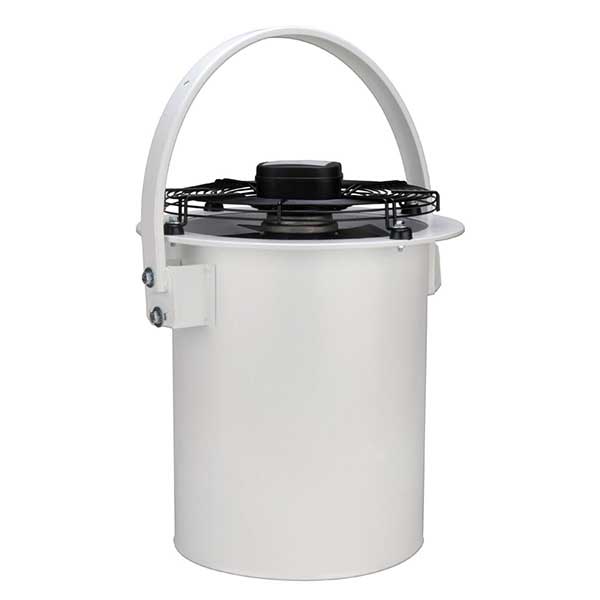
DSF Destratification Fans
Description
DSF destratification fans are designed to reduce hot and cold spots through the mixing of air in large spaces, resulting in significantly reduced energy costs and increased comfort. How does a DSF Destratification Fan help save energy and increase comfort? In order to answer that question, we must first characterize the challenges of heating and cooling buildings with high ceilings.
Challenges of Heating & Cooling
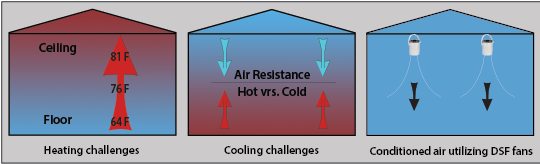
During the heating season, warm air naturally rises into high ceilings, posing a challenge to keep warm air at floor level and maintain a comfortable building environment. For example, if a ceiling is 20 feet high, there can be a 10 to 20 degree variance in temperature from the floor to the ceiling.
During the cooling season, cold air is often discharged through diffusers located at ceiling level. This air is met with resistance by hot air rising from the floor level creating a thermal boundary layer, thus forcing air conditioning units to work harder to maintain a comfortable environment at floor level, and wasting energy trying to keep up with the increased cooling demand.
Solution
DSF fans force heated or cooled air down to floor level, eliminate temperature layers in the ceiling space and ultimately create a more comfortable environment inside the building. The net result is energy savings, along with maximizing the efficiency of an HVAC system.
 ___________________________________________________________
How do I determine how many fans I need?
Air circulation should occur once or twice per hour to maintain a healthy building environment.
Select the fan cfm based on the following ceiling height recommendations:
- 15 ft – 20 ft use 420 cfm fan or model DSF250
- 20 ft – 25 ft use 1,055 cfm fan or model DSF300
- 25 ft – up use 1,460 cfm fan or model DSF350
To determine the number of DSF fans for a given area, the following information is required:
- (L x W x H) = Size of room
- Size of room / cfm / 60 = Number of units
Example: a building is 125 ft. long, 75 ft. wide, and 20 ft. high.
- 125 x 75 x 20 = 187,500 cu. ft.
- 187,500 cu. ft. / 1055 cfm (DSF300 Fan) / 60 = 3 DSF Fans (round to the nearest whole number)
For additional details on applying a destratification fan, download a PDF copy of our Destratification Fan Application Guide!
______________________________________________________________
Features & Benefits of DSF Destratification Fans
- Reduce hot and cold spots through the mixing of air in large spaces
- Lower energy costs, increased comfort
- Ideal for any building with ceilings 15′ or higher
- Breaks up stratification layers
- Powerful, axial flow fan
- External rotor motor design results in superior motor cooling and durability
- Speed controllable using optional solid state speed control
- Permanently lubricated ball bearing motors for maintenance-free operation
- Automatic reset, thermal overload protection
- 120V, 60 Hz operation
- Steel housing with corrosion resistant finish
- Gripple fasteners supplied for safe mounting
- Simple installation
- Rotating mounting bracket permits mounting at any angle
- Maximum permissible ambient temperature: 140 F
- Capacities up to 1,460 cfm
- Available in 10″, 12″ and 14″ fan sizes
Performance
| MODEL | MAX WATTS | MAX AMPS | RPM | CFM |
|---|---|---|---|---|
| DSF250 | 60 | 0.51 | 1700 | 420 |
| DSF300 | 94 | 0.80 | 1675 | 1055 |
| DSF350 | 162 | 1.38 | 1685 | 1460 |
Visit CFM Select to utilize Continental Fan’s state-of-the-art fan selection and quotation platform.
Air Velocity Depending on DSF Fan Distance Point (FT). FPM
| MODEL | 3 | 6 | 10 | 13 | 15 | 20 | 23 | 25 | 30 | 33 | 35 |
|---|---|---|---|---|---|---|---|---|---|---|---|
| DSF250 | 378 | 270 | 220 | 156 | 90 | 60 | 20 | - | - | - | - |
| DSF300 | 918 | 594 | 380 | 234 | 162 | 120 | 79 | 38 | 20 | - | - |
| DSF350 | 1100 | 756 | 760 | 468 | 324 | 300 | 217 | 169 | 120 | 59 | 19 |
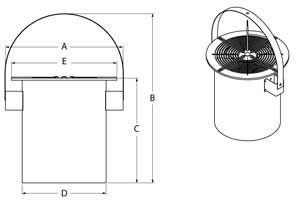
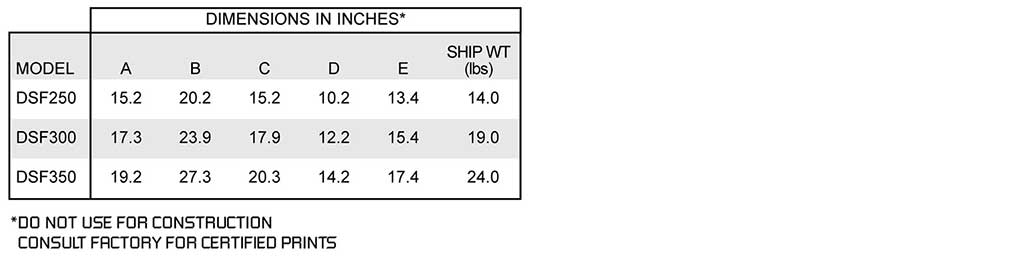
Fan Dimensions
Select Charts / Diagrams tab below
Applications for DSF Destratification Fans

Destratification fans in a grocery store application
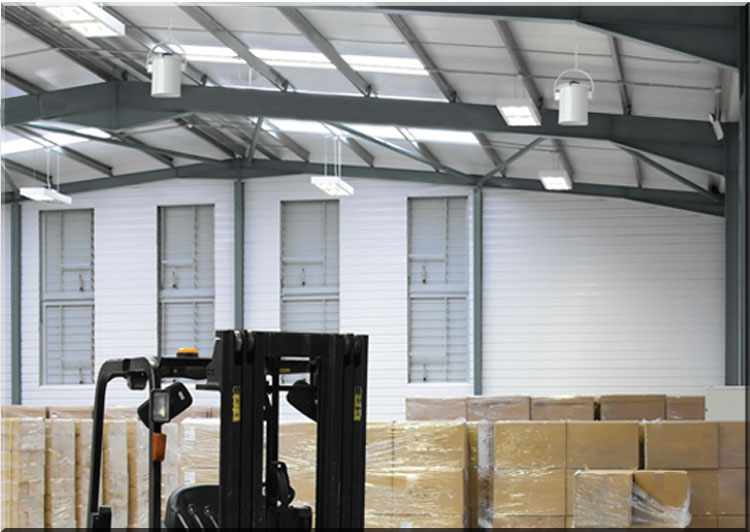
Destratification fans in a warehouse application
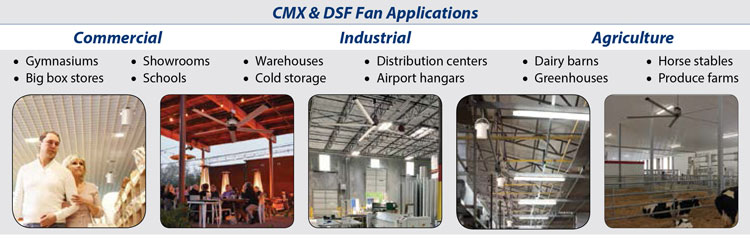
View our Destratification Fan Application Guide to learn more…


1967 Wehrle Drive, Suite 3
Buffalo, New York 14221
10212 Freight Drive
Dayton, Ohio 45377
12-205 Matheson Boulevard East
Mississauga, Ontario L4Z 3E3
1-800-779-4021 | info@continentalfan.com